Tangent Function
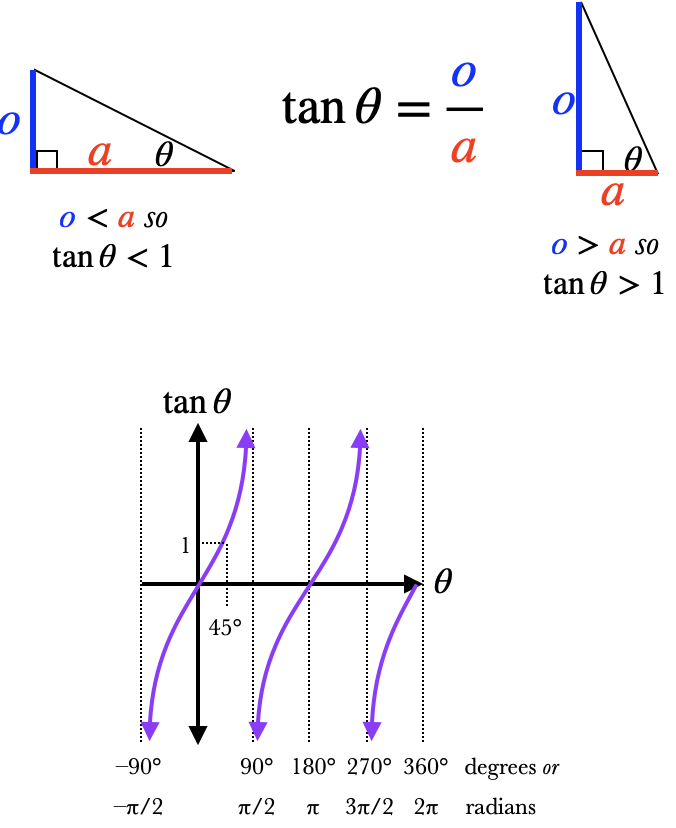
In a right triangle, the tangent of an angle is the ratio of the opposite side over the adjacent side: $$\tan\theta = {o\over a}$$ Because $\sin\theta = o/h$ and $\cos\theta=a/h$, we can show that $$\tan\theta = {\sin\theta\over \cos \theta}$$ When $\theta$ is small, the opposite side will be smaller than the adjacent side, and so $\tan\theta<1$; when $\theta$ is big, the opposite side is bigger, and $\tan\theta>1$. The two sides are of an equal length when $\theta=45\deg$ (when we have an isosceles triangle), and so $\tan45\deg=1$. (From this it follows that $\sin45\deg=\cos45\deg$ too; they both equal $1\over\sqrt2$.)
The tangent function isn't stuck between -1 and 1; it can have any value between $-\infty$ and $\infty$, as shown in the graph.
There are other trigonometric functions which are reciprocals of these three main ones:
- the secant, which is $\sec\theta = \frac1{\cos\theta}$,
- the cosecant, which is $\cos\theta = \frac1{\sin\theta}$, and
- the cotangent, which is $\tan\theta = \frac1{\tan\theta}$.
These are less commonly used now, particularly with the introduction of calculators, and so I list them here only for completeness.