11. (Incomplete)
Small Angles
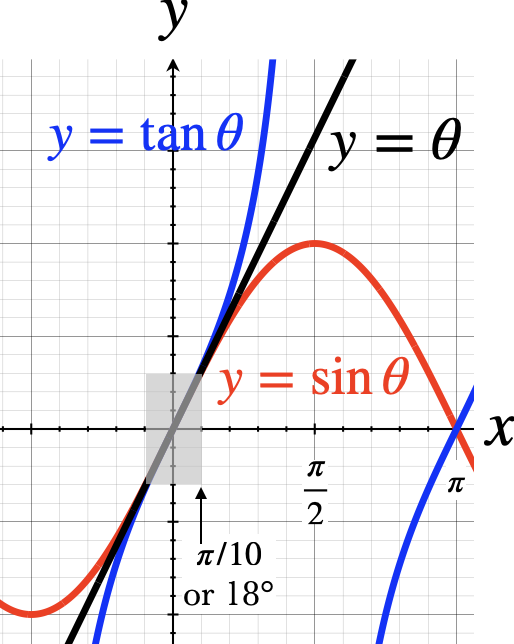
When the angle $\theta$ is small, then the sine of the angle and the tangent of the angle are approximately equal to each other, AND are approximately equal to $\theta$ in radians. $$\sin\theta \approx \tan\theta \approx \theta \hbox{ (in radians)}$$
This approximation is pretty darn good up to about $\pi/10$ or 18°: at this value, the angle, sine, and tangent are all within 5% of each other:
$$\begin{align*} {\pi\over 10}&=0.314\\ \sin{\pi\over 10}&=0.309\\ \tan{\pi\over10}&=0.325\\ \end{align*}$$ Of course, with a calculator it's just as easy to push the SIN or TAN buttons, but this approximation will be useful in some chapters for deriving approximate formulas.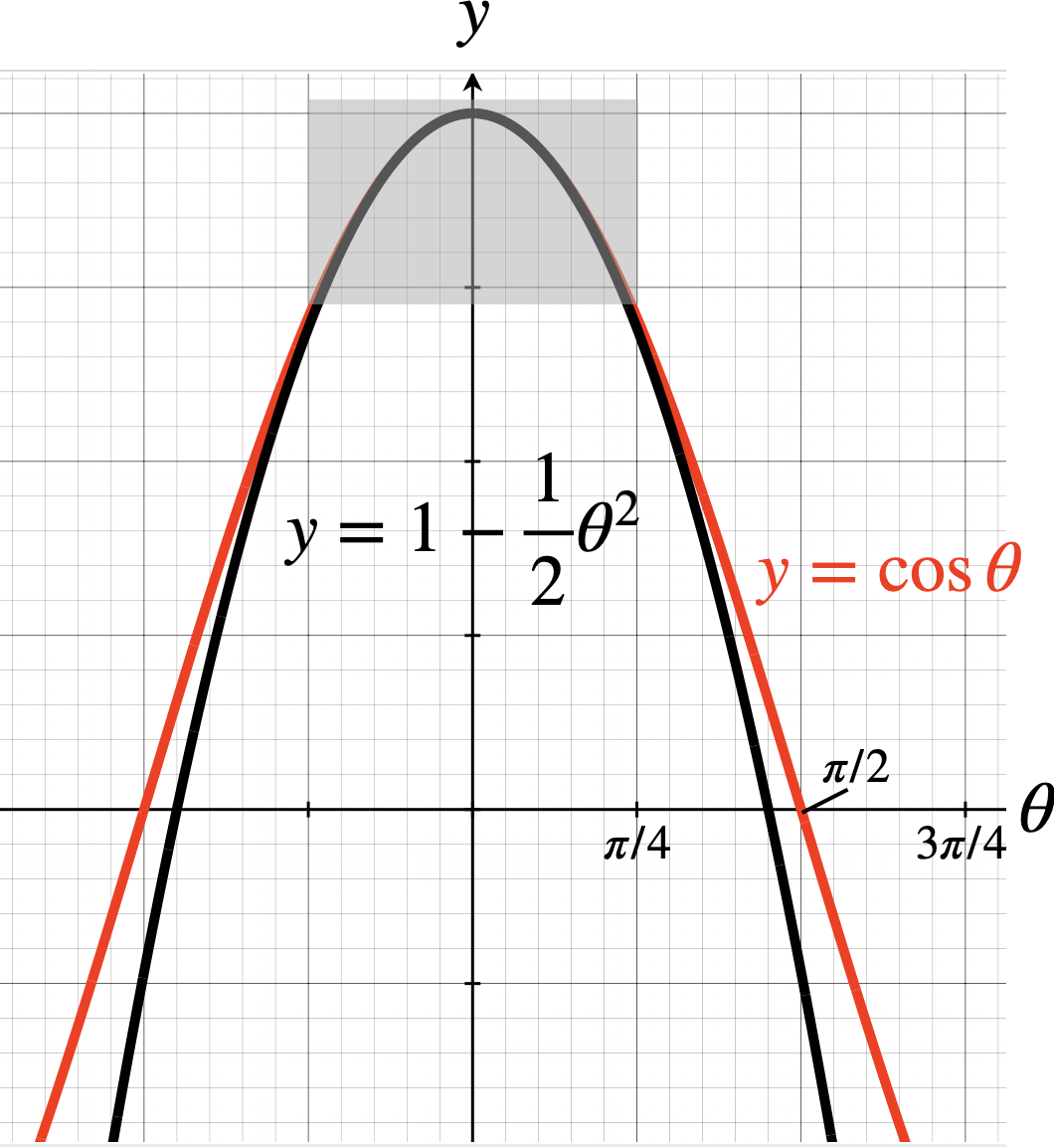
The cosine isn't small when $\theta$ is small; to the contrary it is very close to 1. If you want a better approximation, you can write $$\cos\theta \approx 1-\frac12\theta^2$$
This is a better approximation than for the sine, and is within 2% even at $\theta=\pi/4$ (or 45°). We won't need this approximation in this chapter, however.