Sine Function
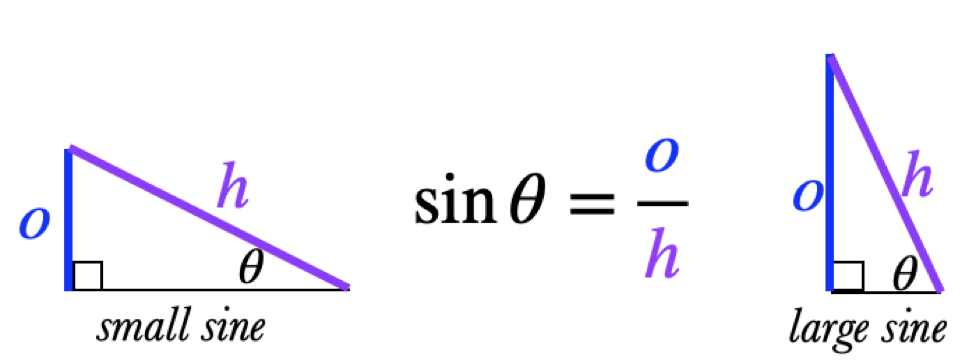
The sine is the ratio of the side opposite of the angle $\theta$ to the hypotenuse: $$\sin\theta = {{\color{blue}o}\over {\color{purple}h}} \implies{\color{blue}o}={\color{purple}h}\sin\theta$$ As the angle gets bigger, $o$ gets bigger (as shown in Figure (a)), and so the sine gets bigger as well, between the limits
$$\begin{align*} \sin 0\deg &= 0\\ \sin 90\deg &= 1 \quad \text{ (or $\sin{\pi \over 2} = 1$ in radians)}\\ \end{align*}$$ The sine is also defined for angles larger than 90° as well, alternating between -1 and 1. For example,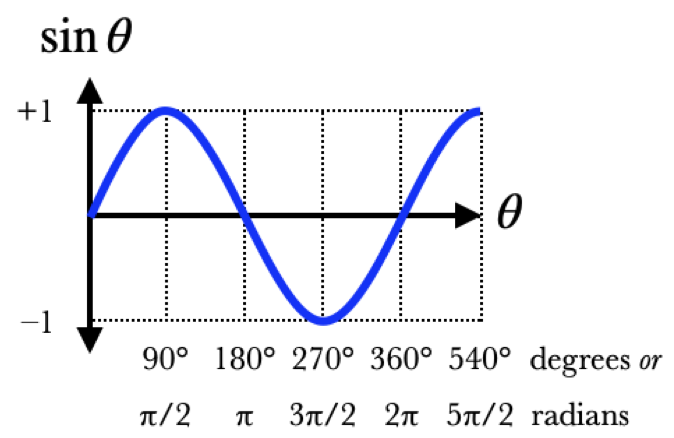
The graph of the sine is a periodic function called the sine wave.
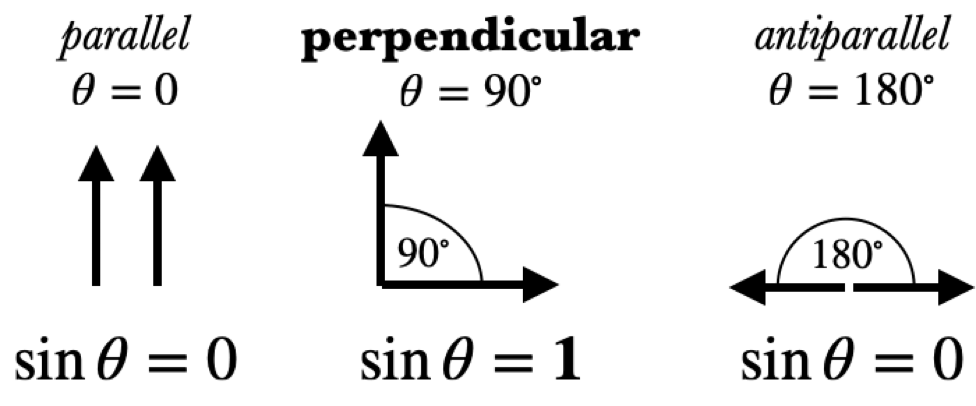
The sine is often used as a measure of how perpendicular two vectors are (as shown in Figure (c)). If the angle between two vectors is $\theta$ and they are pointing in the same direction ($\theta=0\deg$) or in opposite directions ($\theta=180\deg$), then $\sin\theta = 0$. If two vectors are perpendicular to each other ($\theta=90\deg$), then $\sin\theta =1$.