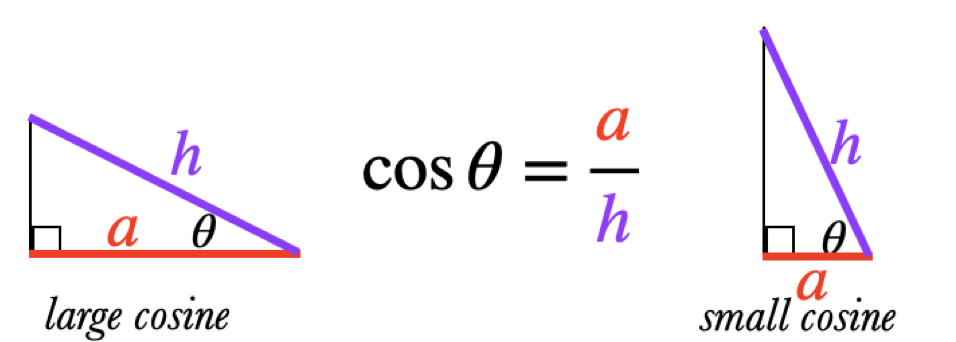
The cosine is the ratio of the side adjacent to the angle $\theta$ and the hypotenuse: $$\cos\theta = {{\color{red}a}\over {\color{purple}h}} \implies{\color{red}a}={\color{purple}h}\sin\theta$$
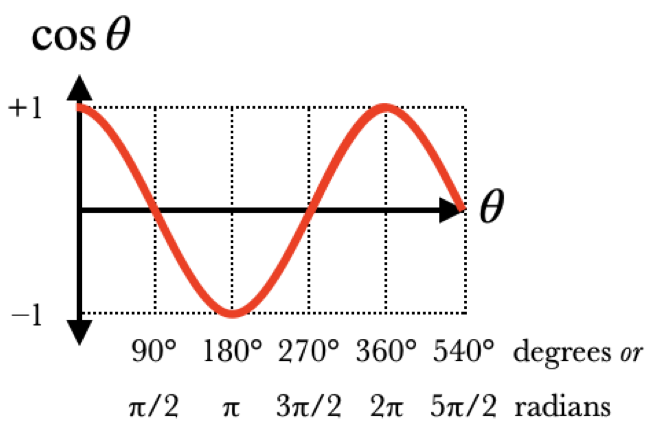
As the angle $\theta$ gets bigger, the cosine gets smaller, between the limits $$\begin{align} \cos 0\deg &= 1\\ \cos 90\deg &= 0 \quad \text{ (or $\cos{\pi\over 2}=0$ in radians)}\\ \end{align} $$ Like the sine, the cosine can also be defined for other angles, and is always between -1 and 1:
$$\begin{align*}
\cos 180\deg&=-1\\ \cos 270\deg&=0\\ \cos 360\deg&=1\\
\end{align*}$$
The graph of the cosine is a periodic function called the cosine wave, and is identical to the sine wave except it is shifted over so that it starts high at $\theta=0$.
The cosine is a measure of how parallel two vectors are. If two vectors are pointing in the same direction ($\theta=0$), then the cosine is 1, because that's as parallel as they get. When they are perpendicular, then they're not parallel at all, and so the cosine is 0. If the vectors point in opposite directions ($\theta=180\deg$), we say they are antiparallel, and their cosine is -1. The cosine is positive if the vectors are roughly pointing in the same direction, and negative if they are pointing in roughly opposite directions.
Note
There's a useful mnemonic to remember the difference between sine and cosine: the co- in cosine means "together" (or you can think "co as in cozy" if you want). Thus a cosine is a measure of how much two vectors "go together" (i.e. point in the same direction). It is also a reminder that the cosine depends on the adjacent side (the one that is "together" with the angle), not the opposite side.