Tension and Pulleys
When a rope or other object exerts a tension force on an object, we say that the rope itself is under tension. For a "massless" rope (an approximation we will assume in this book), the tension in a rope is the same everywhere, although the direction of the tension force it exerts may be different at different points.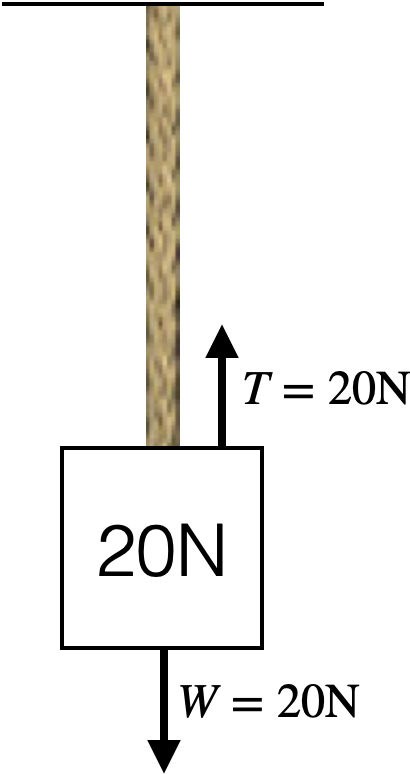
In this figure we have a 20N block (that is, a block with a weight of 20 newtons) suspended from the ceiling by a rope. The block is in equilibrium, so the rope must be balancing the downward force of weight on the block. Thus the rope exerts a tension force of 20N upward, and we say the rope is under 20N of tension.
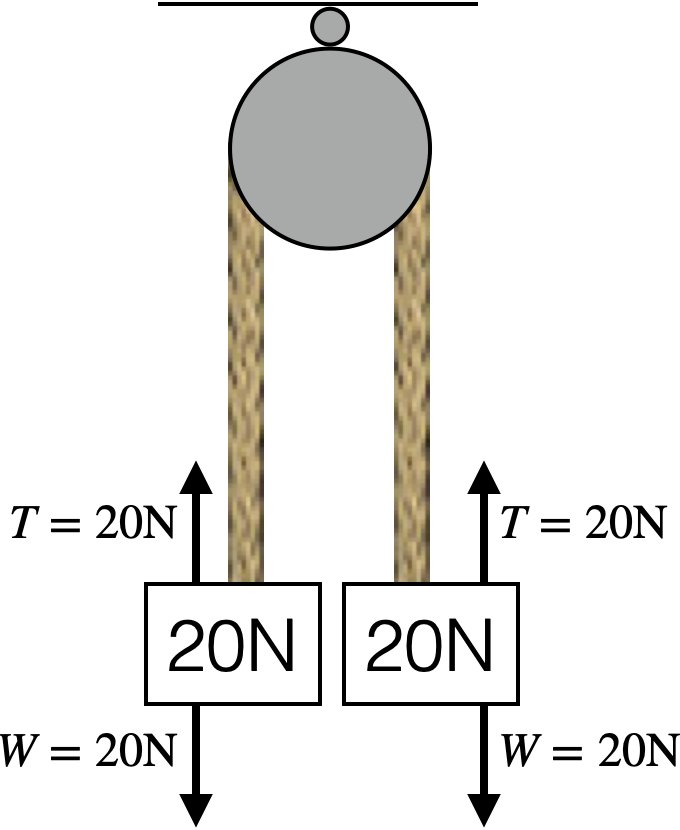
In this next figure, we have two identical masses suspended from a rope which is draped over a pulley, which is a device which allows a rope to change direction and move without (much) interference. The rope exerts a force of 20 newtons on each block, and so the tension in the rope is...still 20N! Surprised? This is a bit nonintuitive, but it may help to remember that the "tension in the rope" is not the same as the total force applied by the blocks. (After all, the pulley is also exerting a force on the rope, and because the rope is not moving the total force on the rope from the blocks and the pulley must be zero.) The general rule of thumb is
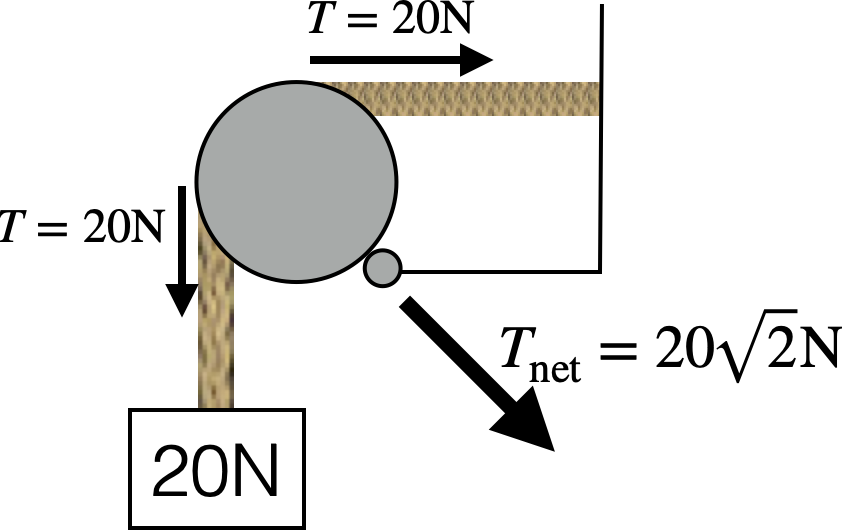
We can find the force of the rope on the pulley by pretending that the two ends of the rope are separate pieces of rope pulling on the pulley. Thus the pulley in the previous figure feels a downward 20N force from the left end of the rope, and a downward 20N force from the right end of the rope, for a total of 40N downward. For example, the rope in this figure has a tension of 20N, because it is suspending the 20N weight. That means that the pulley feels a downward force of 20N and a rightward force of 20N from the two ends of the rope. Adding these two forces together as vectors, we find that the net tension force on the pulley is $T_{net}=\sqrt{20^2+20^2} = \sqrt{800} = 20\sqrt{2}$N down and to the right.
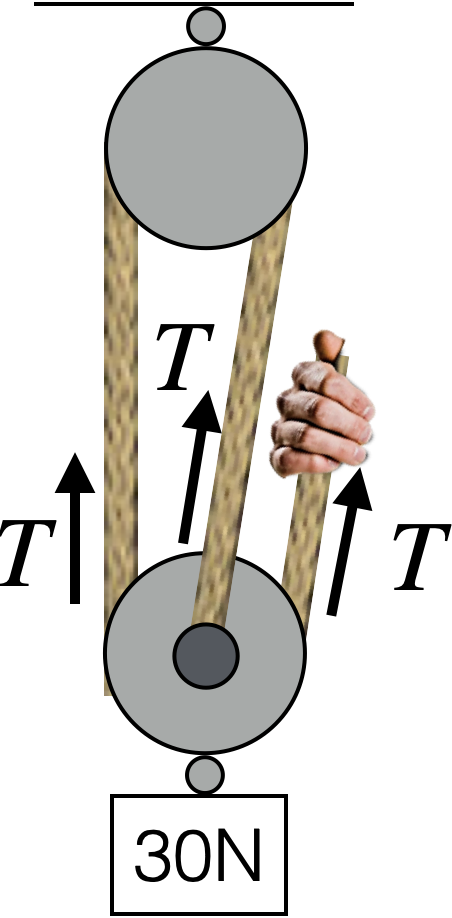
Pulleys are not just useful for changing the direction of a rope, they can also make it easier to lift heavy objects. For example, in this figure a 30N block is suspended from a pulley which is hanging from another pulley by ropes. The rope pulls upward on the lower pulley three times—once on the center, once on the left, and once on the right—and all three forces have the same magnitude $T$. Thus the total force on the pulley is something close to $3T$ upward. (It's a little less because the ropes are all at slightly different angles.) To keep the block from moving, we need to balance $3T$ with the weight of the block, which is $30N$ (assuming the mass of the pulley is negligible), so $3T\approx 30$N or $T\approx 10$N. Thus the hand holding the block up only needs to apply a tension of 10N on the rope, not the full 30N.